Husnah Kukundakwe: Uganda’s First Commonwealth Games Swimming Medal (2026) Ugandan para swimmer Husnah Kukundakwe won silver in the 100m Breaststroke SB8 at the 2026 Commonwealth Games in Glasgow, setting a new Ugandan national record.
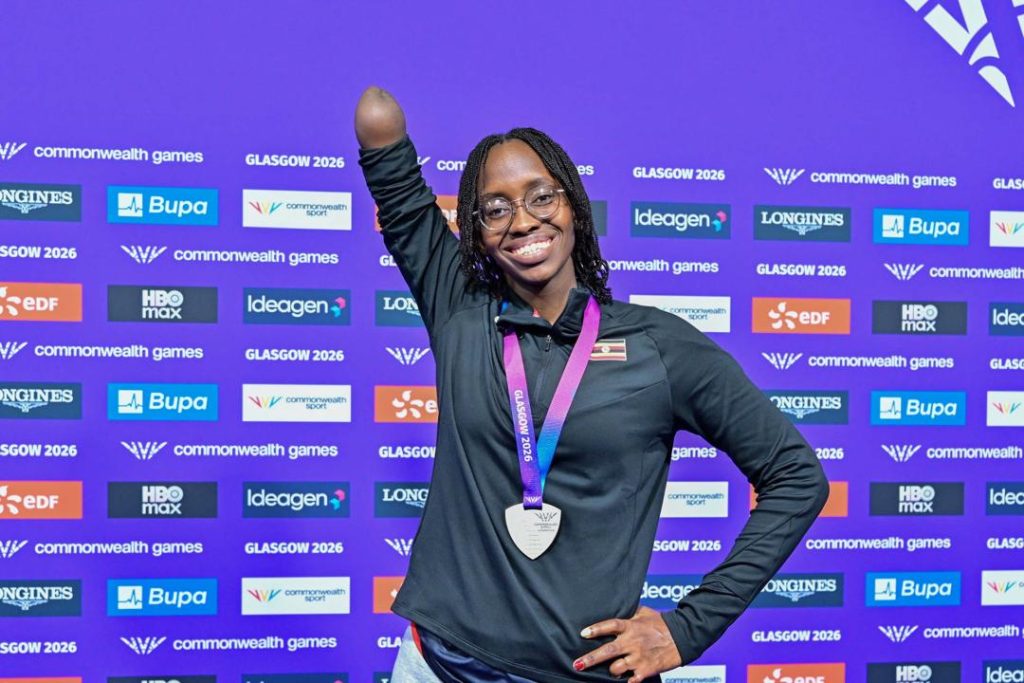
Husnah Kukundakwe’s journey from a young girl who once hid her limb difference to becoming one of Uganda’s most recognised para swimmers is a story of courage, family, hard work and belief.
Uganda’s Husnah Kukundakwe won silver in the Women’s 100m Breaststroke SB8 at the 2026 Commonwealth Games in Glasgow – the first Commonwealth Games swimming medal in Ugandan para sport history, and a new Ugandan national record.
On a night that Ugandans will remember for years to come, 19-year-old Husnah Kukundakwe stepped onto the starting block at the Tollcross International Swimming Centre in Glasgow.
She was about to race for a Commonwealth Games medal.
Less than 90 seconds later, she touched the wall in 1:26.20.
She had won silver in the Women’s 100m Breaststroke SB8.
But this was bigger than a silver medal.
Her time set a new Ugandan national record, and she became the first Ugandan swimmer to win a Commonwealth Games medal.
For Husnah, however, the medal was not won in those 90 seconds.
It was built over years of early mornings, difficult training sessions, family sacrifice, international competition and a young girl learning to stop hiding who she was.
A Historic Race for Uganda
Husnah went into the Women’s 100m Breaststroke SB8 final knowing she had a real opportunity to make history.
She got off the blocks quickly, recording the fastest reaction time among the finalists at 0.73 seconds.
At 50 metres, she turned in 39.67 seconds, putting herself firmly in the medal conversation.
Great Britain’s Brock Whiston eventually took gold in 1:22.05, but the battle for silver went right down to the final metres.
Husnah was racing England’s Iona Winnifrith, and the gap between them was tiny.
As fatigue set in during the final 10 metres, Husnah had to dig deep.
She did.
She touched the wall in 1:26.20, just 0.11 seconds ahead of Winnifrith, who finished in 1:26.31.
Silver belonged to Uganda.
And history had been made.
As fatigue set in during the final 10 metres, Husnah had to dig deep.
She did.
She touched the wall in 1:26.20, just 0.11 seconds ahead of Winnifrith, who finished in 1:26.31.
Silver belonged to Uganda.
And history had been made.
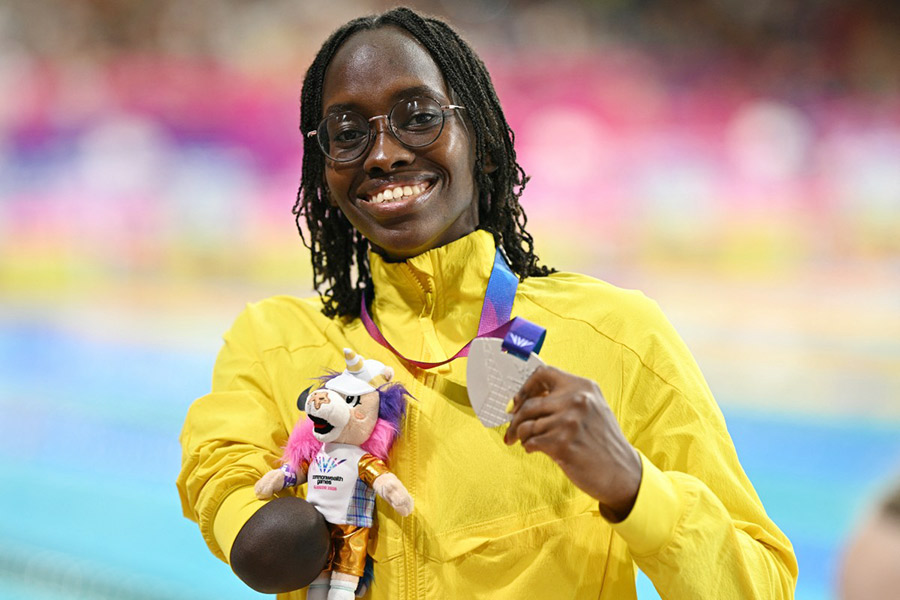
Final results: Women’s 100m Breaststroke SB8, 2026 Commonwealth Games, Glasgow
| Athlete | Country | Time | Result |
| Brock Whiston | Great Britain | 1:22.05 | Gold |
| Husnah Kukundakwe | Uganda | 1:26.20 | Silver |
| Iona Winnifrith | Great Britain | 1:26.31 | Bronze |
For Uganda, this was not simply another medal.
It was a moment that showed what is possible when a talented young athlete is given the opportunity, support and environment to grow.
But Husnah’s Story Started Long Before Glasgow
To understand what the Commonwealth Games medal means, you have to go back to Kampala.
Husnah was born on 25 March 2007 at Lubaga Hospital with a congenital limb impairment. She was born without her lower right arm and with three full fingers on her left hand.
Growing up, she quickly learned that being different could attract attention.
People stared.
Some whispered.
Others made hurtful comments.
As a young girl, Husnah became uncomfortable with people looking at her. She often wore long-sleeved clothes to hide her arm.
It was a way of protecting herself.
She was talented and curious, but she was also a child trying to understand why people treated her differently.
Then swimming changed something.
The Swimming Pool Became Her Safe Place
Husnah started swimming when she was very young.
In the water, something important happened.
People were no longer focused on her arm.
They were focused on her swimming.
The pool became a place where her physical difference mattered less than her ability to move through the water, compete and improve.
But her journey was not always easy.
During one early inter-school competition, officials removed her from a race because of her disability.
It was painful and confusing.
But instead of ending her relationship with swimming, the experience strengthened her determination
She wanted to prove that she belonged.
And she did.
The Moment Husnah Stopped Hiding
One of the biggest turning points in Husnah’s life came when she was about 11 years old.
She travelled to Nairobi, Kenya, for her first international experience and found herself surrounded by athletes with different physical impairments.
For the first time, she saw people who looked different from her competing confidently and openly.
They were not hiding.
They were athletes.
That experience changed how Husnah saw herself.
She stopped wearing long sleeves to hide her arm.
She began appearing in photographs with confidence.
And slowly, the thing she had once wanted to conceal became part of the story she was proud to tell.
That transformation is perhaps one of the most powerful parts of her journey.
Before Husnah could become an international medalist, she first had to believe that she belonged.
The Support System Behind the Medal
Behind many successful athletes is a support system that the public rarely sees. For Husnah, that meant family, coaching, and the National Paralympic Committee – during her hardest stretch – creative problem-solving when the world shut down.
The Mother Who Refused to Give Up
For Husnah, one of the most important people in that system has been her mother, Hashima Patience Batamuriza.
At first, her mother was understandably afraid.
She worried that a child with one arm could be safe in the water.
But Husnah changed her mind.
At just nine years old, Husnah competed at a local swimming competition and managed to beat able-bodied swimmers without flotation assistance.
Her mother saw something.
This was not simply a child who enjoyed swimming.
This was an athlete.
From that point, Batamuriza became much more than a mother watching from the side of the pool.
She became Husnah’s team manager, advocate, organiser and one of her strongest supporters.
When the Money Wasn’t There, the Family Found a Way
Becoming an elite para athlete is expensive.
There are training costs, equipment, travel, accommodation, competition fees and many other expenses that people don’t always see.
In Uganda where Uganda Paralympic Committee is mandated by Law to Develop, Promote and cordinate Sports for Persons with Imopariments from grassroot to elite, para sport does not always have access to the resources available due to resource constriants from the national budget, families end up carrying a significant part of the burden to see athletes achieve their dreams.
Husnah’s family was no different.
Her mother helped raise money for to foot for some bills where the NPC is short of.
When Husnah qualified for the 2019 World Para Swimming Allianz Championships in London, her mother’s fundraising efforts helped make it possible for Husnah, her coach and manager to travel.
Her father, Ahmed Asiimwe, also played an important role.
During the COVID-19 pandemic, swimming pools and training facilities were closed. Rather than allowing Husnah to stop completely, her father and older brothers helped her continue training on land.
They ran together.
They worked on conditioning.
They kept her physically active.
And Coach Muzafaru Muwanguzi continued providing technical guidance remotely.
It was a family effort.
The Coach Behind the Champion
Family support created the foundation, but elite performance also requires expert coaching.
For Husnah, that has been Coach Muzafaru Muwanguzi of Gators Swim Club Kampala.
Coaching a para swimmer is not simply about adapting an existing programme.
Every athlete has different physical characteristics, strengths and challenges.
Husnah’s coach had to understand how her limb difference affected her movement in the water and how to help her become as efficient and powerful as possible.
Her training placed significant emphasis on her core strength, lower-body power, kicking efficiency, starts and race technique.
And the workload was serious.
Support from the Uganda Paralympic Committee and International Paralympic Committee
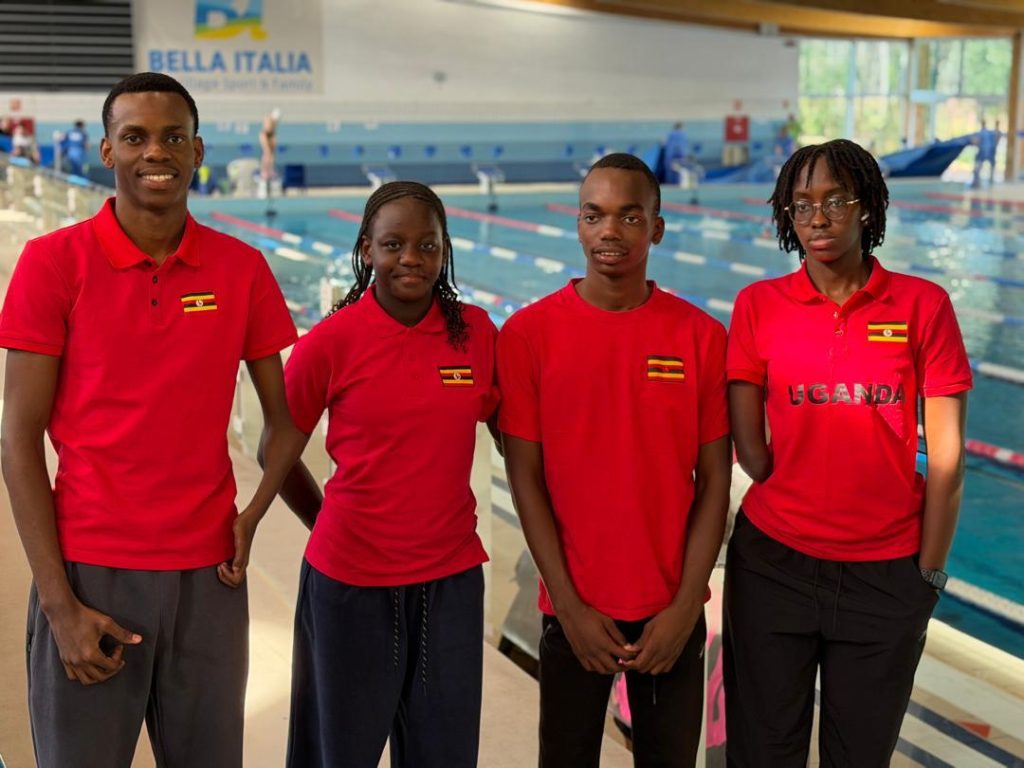
Alongside her family and coach, the Uganda Paralympic Committee has been a steady source of support behind Husnah’s rise, particularly when it comes to training and international Competitions.
The Committee has helped Husnah access consistent training support and has backed her participation in major international events, including the World Para Swimming Series and the World Para Swimming Championships, giving her the platform to keep testing herself against the world’s best.
The IPC picked interest in Husnah early and gave her the support and platform to advocate and advance her swimming career.
The Early Mornings Behind the Medal
Husnah’s success did not come from talent alone.
Her routine required discipline.
Her days could begin around 4:00 a.m.
After dry-land preparation, she would enter the pool early in the morning for training focused on areas such as sprint power, starts and race pace.
Then came school.
And after school, there was another training session.
Her afternoon sessions focused on endurance, stroke technique and maintaining performance even when tired.
This meant balancing elite sport with education.
It is easy to look at the medal ceremony and see the smile.
It is harder to see the alarm clock going off before sunrise.
The tiredness.
The repetition.
The days when training was difficult.
The schoolwork that still had to be completed.
That is the part of elite sport that the medal does not show.
From Kampala to the World Stage: Husnah Kukundakwe’s Career Timeline
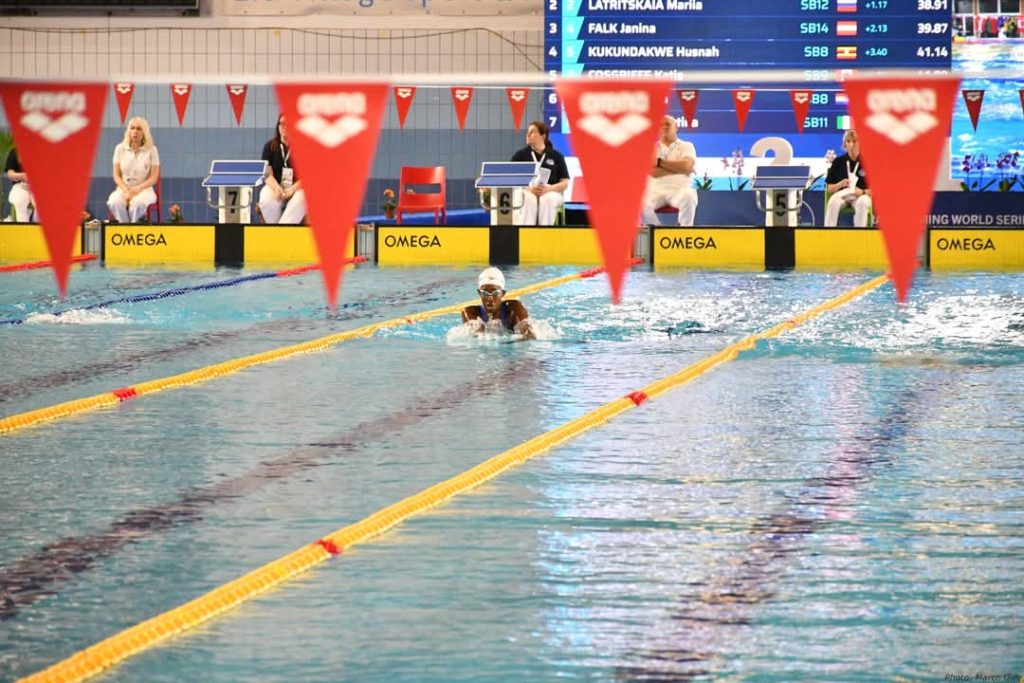
Husnah’s career has developed steadily over the years. Her international journey includes some remarkable milestones:
- 2017: Began gaining competitive experience in swimming events in Uganda.
- 2018: Won gold at the Korea Paralympic Youth Camp.
- 2019: Competed at the World Para Swimming World Series in Singapore, recording three personal bests and undergoing international classification.
- 2019: Represented Uganda at the World Para Swimming Championships in London.
- 2021: Competed at the Tokyo 2020 Paralympic Games at just 14 years old and recorded a personal best in the 100m Breaststroke SB8.
- 2022: Won Uganda’s first International Para Swimming medals at the World Series in Lignano Sabbiadoro.
- 2022: Won six medals at the Islamic Solidarity Games in Konya — two gold, three silver and one bronze.
- 2023: Reached the final of the 100m Breaststroke SB8 at the World Para Swimming Championships in Manchester and secured qualification opportunities for Paris 2024.
- 2024: Competed at the Paris 2024 Paralympic Games.
- 2026: Won silver in the 100m Breaststroke SB8 at the Commonwealth Games in Glasgow, setting a new Ugandan national record.
Each competition added something.
Experience.
Confidence.
Race awareness.
Mental strength.
And belief.
By the time Husnah arrived in Glasgow, she was no longer the young swimmer simply hoping to compete internationally.
She had become an athlete capable of challenging the best.
More Than a Swimming Medal
Husnah’s importance goes beyond the swimming pool.
For many Ugandans, especially young people with disabilities and parents raising children with disabilities, her visibility matters.
A child watching Husnah compete can see something that is sometimes missing in society:
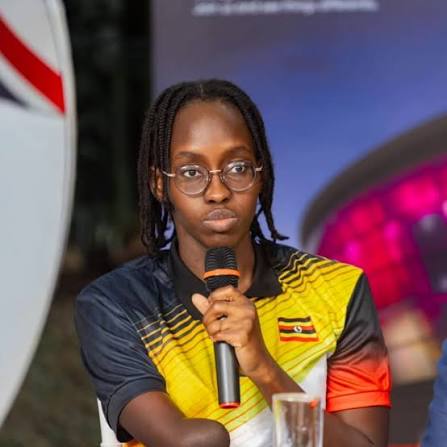
possibility.
Her story challenges the idea that disability should automatically limit someone’s ambitions.
She has also used her platform beyond competition, including through her work as an IPC Youth Ambassador and United Through Sports Young Leader.
She has spoken about disability inclusion and participated in international advocacy initiatives focused on creating a more equal world.
Her journey therefore has two sides.
There is Husnah the athlete.
And there is Husnah the young woman using her platform to change how people think about disability.
Husnah the Student
Sport is only one part of Husnah’s ambition.
She has also taken her education seriously.
She completed her O-Level education at Aga Khan High School with strong results before continuing at Kabojja International School, where she studied Biology, Chemistry and Mathematics.
Her long-term ambition is to become a doctor, specifically a paediatrician.
Interestingly, that dream is connected to her own childhood.
Growing up with a congenital limb difference made her curious about the human body and medicine. She wants to understand more about her own experience while eventually using that knowledge to help other children.
It is another reminder that Husnah is not defined by swimming.
She is an athlete.
A student.
An advocate.
A daughter.
And a young Ugandan woman with ambitions that extend far beyond the pool.
Frequently Asked Questions About Husnah Kukundakwe
Who is Husnah Kukundakwe?
Husnah Kukundakwe is a Ugandan para swimmer and Paralympic athlete. She competes internationally in events including the 100m Breaststroke SB8 and other S8/S9 and SM8/SM9 classifications.
How old is Husnah Kukundakwe?
Husnah Kukundakwe was born on 25 March 2007. She was 19 years old when she won silver at the 2026 Commonwealth Games in Glasgow.
What medal did Husnah Kukundakwe win at the Commonwealth Games?
Husnah won silver in the Women’s 100m Breaststroke SB8 at the 2026 Commonwealth Games in Glasgow.
What was Husnah Kukundakwe’s time in Glasgow?
She finished in 1:26.20, setting a new Ugandan national record according to the competition result reported here.
Is Husnah Kukundakwe the first Ugandan swimmer to win a Commonwealth Games medal?
Yes. Her silver medal in Glasgow became Uganda’s first Commonwealth Games medal in swimming.
What is Husnah Kukundakwe’s disability?
Husnah was born with a congenital limb impairment. She has no lower right arm and has three full fingers on her left hand.
When did Husnah Kukundakwe start swimming?
Husnah was introduced to swimming when she was very young, beginning basic swimming activities at around three to five years old.
Who is Husnah Kukundakwe’s coach?
Her long-time coach is Muzafaru Muwanguzi, who has coached her through her development into an international para swimmer.
Who supports Husnah Kukundakwe?
The Government of Uganda through National Council of Sports, the Uganda Paralympic Committee, and her family have played a major role in her career. The Uganda Paralympic Committee has been especially involved in supporting her training and her participation in international events such as the World Para Swimming World Series and World Championships. Her mother, Hashima Patience Batamuriza, has served as an important manager and advocate, while her father and brothers also supported her training, particularly during the COVID-19 pandemic.
What is Husnah Kukundakwe’s classification?
Husnah competes across several para swimming classifications, including S8, S9, SB8, SM8 and SM9, depending on the event.
Has Husnah Kukundakwe competed at the Paralympic Games?
Yes. She competed at the Tokyo 2020 Paralympic Games and later competed at the Paris 2024 Paralympic Games.
What does Husnah Kukundakwe want to do in the future?
Alongside her swimming career, Husnah has ambitions of pursuing medicine and becoming a paediatrician.
A Medal That Represents So Much More
Husnah Kukundakwe’s Commonwealth Games silver medal is easy to describe in numbers.
1:26.20.
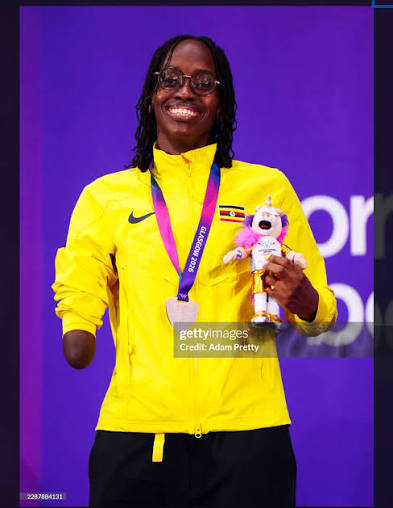
Silver medal.
Ugandan national record.
But numbers cannot tell the whole story.
They cannot tell us about the little girl who once used long sleeves to hide her arm.
They cannot tell us about a mother who had to overcome her own fears and then became her daughter’s strongest advocate.
They cannot tell us about the family members who ran with her when swimming pools were closed.
They cannot tell us about the coach who spent years adapting training to help her reach her potential.
And they cannot tell us about the young athlete who learned to look at herself differently.
That is why Husnah’s story matters.
Her Commonwealth Games medal belongs to her, but it also belongs to everyone who believed that a young Ugandan girl with a disability could dream bigger.
From Kampala to the international swimming stage, Husnah has shown that disability does not have to be the end of the story.
Sometimes, it is simply the beginning.
And if Glasgow has shown us anything, it is that Husnah Kukundakwe’s story is far from finished.

